
Fields Inside Warren County Property Tax Records
A Delta tax card holds parcel identity, appraisal figures and payment rows on one screen. Always check the tax year first. Comparing the record to another source before that step invites errors.
| Field | What It Shows | Where |
|---|---|---|
| Land and improvements | Separate appraisal components and a combined total. | Tax Assessor / Delta |
| Assessed value | The value to which the applicable millage is applied. | Tax roll |
| Exemption and homestead codes | Whether relief is reflected on that annual record. | Tax roll |
| Due, paid and balance | Payment status for each displayed jurisdiction. | Delta tax result |
| Tax district | The administrative district code attached to the parcel. | Tax roll |
| Tax-sale history | Sale year, purchaser and redemption information when present. | Delta / Chancery |
Mississippi assesses owner-occupied residential real property at 10 percent of true value. Most other real property gets 15 percent. Confirm classification and exemptions for the specific parcel, because a tax bill is neither a market appraisal nor a recorded sale price.
A Real Warren County Tax Card, Field by Field
The Delta result for PPIN 019674 is a 2025 tax snapshot. Land value came in at $7,150. Improvements added $21,520, for a total value of $28,670 and an assessed value of $4,301. County, city and school rows totaled $668.98, all paid, with a zero balance and a December 29, 2025 last-payment date. The homestead field read None. Open the Warren County sample tax card alongside it.
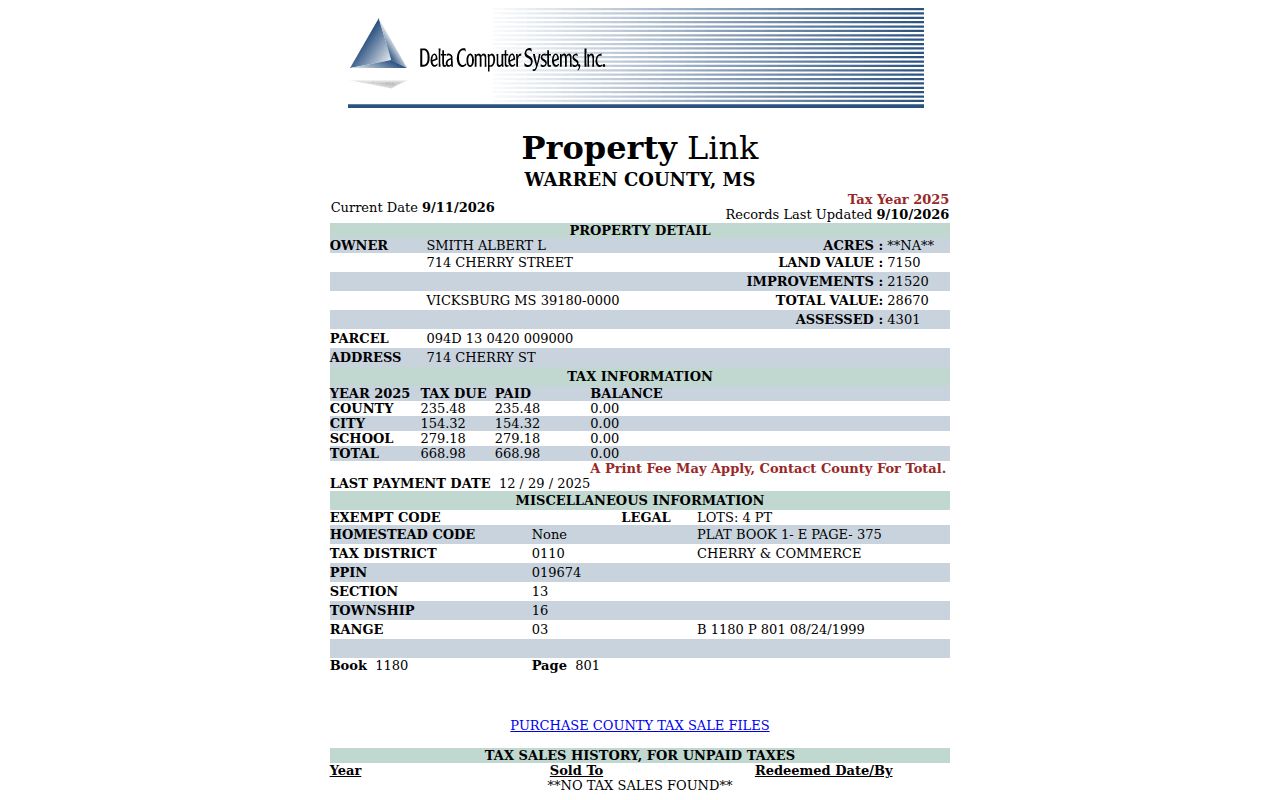
One screen can carry values, payment rows, legal description and tax-sale history together on a single annual record. The amounts describe that one parcel and year alone.
Do Not Merge Warren County Tax Years
The linked appraisal card shows tax year 2026 and a total parcel value of $32,970. The tax result was a 2025 view at $28,670. That gap is not a contradiction. The two records cover different years and purposes. Beyond the numbers, the appraisal card adds lot size, land-use class, a sketch, tax map, vacancy indicator, building description and field-work dates. Review the sample Warren County appraisal card for the later-year view.
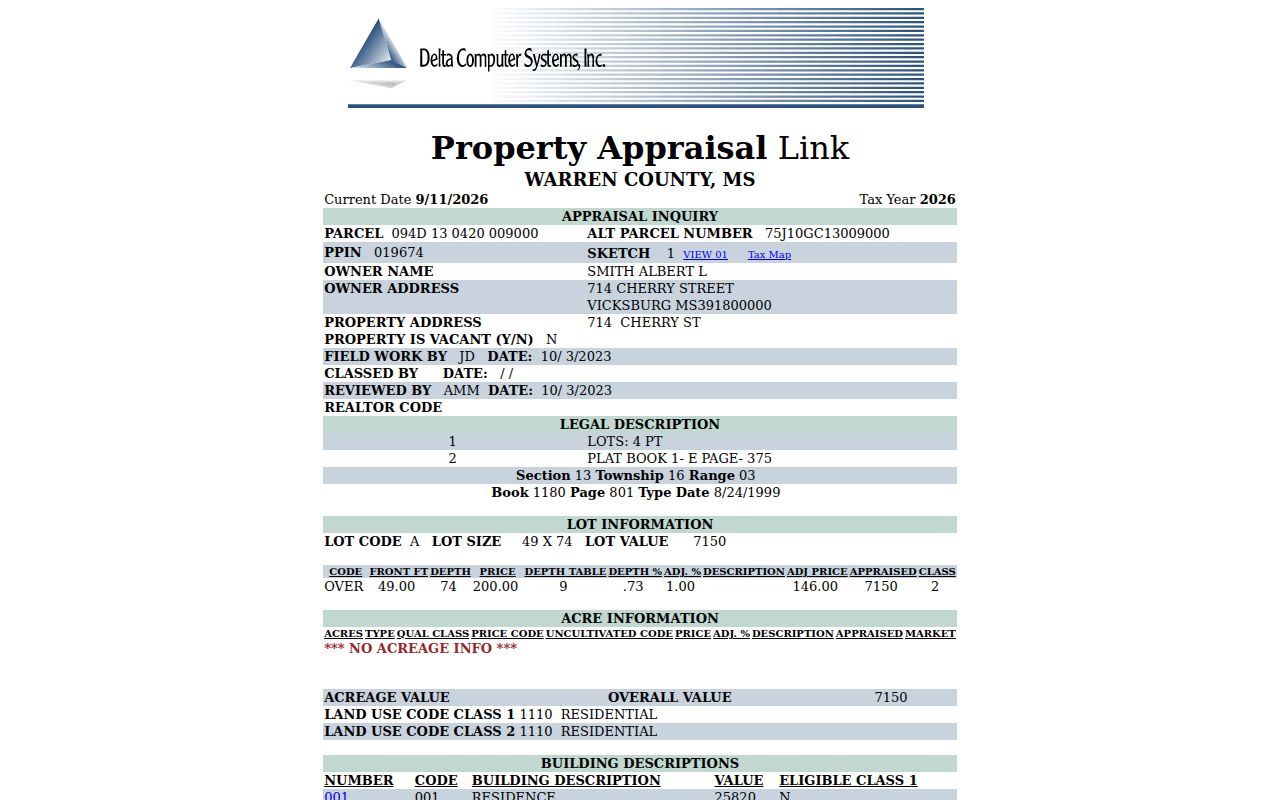
Label every screenshot with its tax year, parcel identifier and access date. Evidence for a correction or appeal earns little trust without those labels.
Note: Delta warns that frequent uploads may not exactly match courthouse activity, so confirm time-sensitive figures with the responsible office.
Look Up a Warren County Tax Bill
Start at the Delta real-property search. Address and owner searches work for discovery, but a parcel number or PPIN gives the cleanest match once you have it.
- Search by address, owner, parcel, PPIN or rural section/township/range.
- Verify the situs, parcel and tax year before reading amounts.
- Record county, city and school due, paid and balance rows separately.
- Check exemption, homestead, tax district and tax-sale history fields.
- Call the appropriate office when an online balance will affect a transaction.
- Assessed value
- The classified value used with millage to calculate tax.
- Millage
- Dollars of tax per $1,000 of assessed value.
- Homestead exemption
- Qualified owner-occupied relief that affects tax liability.
- Tax lien
- The public claim arising from unpaid property tax.
Assessor, Collector and Chancery Have Different Jobs
| Office | Primary role | Use it when |
|---|---|---|
| Tax Assessor | Parcel appraisal, roll, mapping and homestead | A value, classification, parcel detail or exemption looks wrong. |
| Tax Collector | Ad valorem bills, payments and annual tax-sale administration | You need current payment routing or sale procedures. |
| Chancery Clerk | Delinquent amount handoff, redemption and recorded tax-title documents | A parcel is delinquent, sold, redeemed or moving toward a tax deed. |
The Assessor sits at 1009 Cherry Street, 601-638-6161. The Tax Collector answers at 601-638-6181 or taxcoll@warrencountyms.gov, while county pages route current delinquent-amount questions to the Chancery Clerk at 601-636-4415.
Homestead Changes Tax, Not the Deed
Homestead applications run January 2 through April 1. File with the Assessor, not the Tax Collector. Paperwork can include ownership and occupancy evidence fitting the claim. A blank exemption code stays on that card. So does a homestead value of None; each describes one annual tax record. Homestead treatment can lower the bill. It does not touch the owner of record, deed language or parcel boundary. The reverse also holds: an owner field proves no exemption. So keep assessment relief separate from title analysis.
Warren County Delinquency and August Sale
Warren County's annual real-estate tax sale lands on the last Monday in August. Bidding runs online through Govease. The delinquent list usually runs in The Vicksburg Post during the second week of August. Registration details can change, so follow the county's current instructions.
An August 26, 2026 county update gives a concrete redemption example. A property sold August 26, 2024 for fiscal year 2023 has two years to redeem. The county warns that a later tax deed does not provide clear title. Chancery Court confirmation may be necessary. A sale row is only a clue. It is not proof of marketable ownership.
Save the right fields from any sale record. They include parcel number, owner, abbreviated legal description, sale year, redemption deadline, roads, section, township and range. Check each against the current Delta card. A delinquent notice can outlive the ownership or payment status it first reported, and a redeemed parcel should be read beside the clerk's redemption record rather than as an open balance.
Confirm the live registration steps before bidding. County materials have listed a W-9, a bank letter showing good standing and a signed blank check without a date, though those requirements can change. The Tax Collector runs the sale. Govease hosts the auction. Chancery handles the later delinquent amount, redemption and tax-deed route, so separating those duties keeps an auction page from standing in for a title conclusion.
Older Warren County Tax Evidence at MDAH
The Mississippi Department of Archives and History preserves Warren County records across an 1807-1987 finding-aid span. Nineteenth-century assessments, insolvencies, land-sale material and 1895-96 tax-collector cash books all appear. They show landholding and tax distress far earlier.
Archival search works differently. Series, content, volume, date, district and microfilm roll drive the lookup, not a modern street address. Start with the legal description and historic owner. Then translate both into the period's subdivision, section or former street language.
Historic tax books work best as corroboration. They can bind a name to land. They can also reveal delinquency or assessment changes, but they never replace the conveyance recorded in a deed book. When an archival entry and the deed chain appear inconsistent, note both dates. Then consult the deed, probate, partition or tax-sale file.
Challenge a Warren County Assessment in August
Warren County follows a fixed assessment calendar. Real property is valued from January 1 through June 30. The roll is published in July, and equalization review falls in August. A taxpayer who disputes an assessment should start with the Assessor. Review the property and classification data to pin down the exact factual issue. The Board of Supervisors serves as the county board of equalization. Strong evidence helps. Bring the parcel and PPIN, current photos, measurements, damage documentation, comparable assessment records, an independent appraisal, deed or survey material, and a copy of the challenged annual card. The county publishes no standalone appeal form. So confirm the meeting date, submission format, and deadline with the Assessor's office directly.
Appeal window. Warren County equalization review occurs in August; contact the Tax Assessor promptly for the current deadline and Board of Supervisors procedure.
Correct a Warren County Tax Record
Not every discrepancy needs a valuation appeal. A misspelled owner may instead belong to a correction workflow at the Assessor. So may a wrong mailing address, incorrect property address, parcel mismatch, omitted building fact, or questionable exemption code. Bring the parcel and the PPIN. Include the disputed tax year, a screenshot or printout, and whatever document supports the change. For a recent purchase, include the recorded-deed reference. Delta can lag courthouse activity. Payment problems belong with the Tax Collector. Redemption or delinquent-amount questions may route to Chancery. Ask the receiving office which record controls and for which tax year. Keep a dated copy of the inquiry and the response. That way a later annual snapshot is not mistaken for the record you challenged.
Compare Tax Data Without Overclaiming Value
For buying or selling diligence, compare like fields from the same year and property class. Land value, improvement value, and total appraisal each answer a different question. Assessed value and tax balance do too. A recorded deed may hold consideration or transfer-tax clues. But that figure can differ from market value. It also belongs in the instrument's own context. A tax sale bid is another number entirely. It does not establish ordinary market value. Neighborhood comparisons work best with parcels of similar use, location, lot characteristics, and improvement type. Historic-district or zoning status can shape review requirements and property context. It does not automatically create an exemption or a set value. For valuation categories, see the Warren County home value guide. For boundaries, use the parcel map guide.